The Wounded Human in the Loop in the AI War on Iran

By Dr. Ameneh Dehshiri, AI law and policy expert
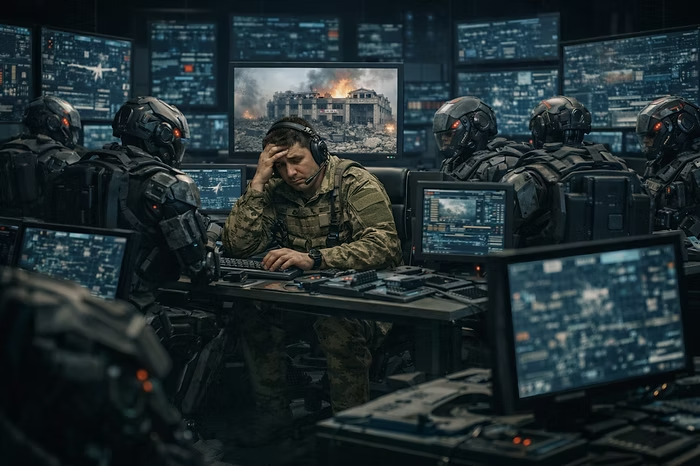
When the United States and Israel launched coordinated strikes on Iran on February 28, 2026, headlines focused on targets, escalation, and retaliation. Beneath the surface, something more consequential was unfolding. This was not just another military campaign. Even early assessments described it as a turning point, a moment when artificial intelligence moved from the margins of warfare to its operational core.
What made this war different was not simply the presence of AI, but its role. AI was not assisting the war. It was structuring it.
That shift cast new light on an otherwise obscure dispute that erupted just hours before the first strikes. When Anthropic refused to allow its technology to be used in fully autonomous weapons and mass domestic surveillance, Washington responded quickly. The Trump administration ordered federal agencies to stop using the company’s tools. Within days, alternatives were in motion. Early indications that Anthropic’s Claude had been used within Project Maven through Palantir-built systems gave way to news that OpenAI had stepped in.
This was not a routine procurement dispute. It exposed a deeper tension between the speed at which states are integrating AI into warfare and the limits that even the companies building these systems are willing to accept.
To understand why this matters, it helps to go back to Project Maven. Launched in 2017 with Palantir as a central contractor, Maven was initially framed as a decision support tool designed to help analysts process large volumes of visual and signals intelligence. For years, it remained largely out of public view. The war in Iran changed that. Fragments of information once buried in technical briefings became subject to scrutiny.
What emerged was a picture of warfare operating at a different tempo. In less than two weeks, the campaign reached a scale that would once have taken months. Roughly 6,000 targets were struck, thousands of sorties flown, and dozens of Iranian naval assets destroyed.
These numbers are staggering, but they tell only part of the story. The more important shift lies in how those targets were identified, processed, and engaged. This is what it means to fight at AI speed. Not just faster weapons, but faster decisions.
Public debate often reduces AI in warfare to a single question: are autonomous weapons being used or not? That framing misses the broader reality. AI is now embedded across the full spectrum of military activity, shaping intelligence analysis, target generation, and operational planning.
Legally, a distinction is still drawn between autonomous weapon systems that select and engage targets without human intervention and decision support systems where humans remain in control. On paper, the difference is clear. In practice, it is fading.
Systems that fall short of full autonomy can still produce outcomes that resemble it. When targets are generated through pattern recognition, when recommendations arrive faster than they can be meaningfully reviewed, and when timelines shrink to seconds rather than minutes, the role of the human changes. Decision making turns into validation.
This is not incidental. It is reflected in doctrine. The Pentagon’s 2026 AI strategy does not explicitly call for full autonomy, but its direction is clear. By adopting an AI first model, integrating AI from campaign design to execution, deploying networks of autonomous agents, and prioritizing speed over deliberation, it reshapes the battlefield in ways that weaken meaningful human control. In this model, autonomy is not a feature of a single weapon. It is a property of the system as a whole.
Official statements insist otherwise. US military leaders continue to emphasize that human judgment remains central. Admiral Brad Cooper, head of US Central Command, stated that while AI tools can process vast amounts of data in seconds, humans will always make the final decisions on what to shoot. Pentagon spokesperson Sean Parnell similarly noted that the Department of Defense does not intend to develop weapons that operate without human involvement.
These assurances sit uneasily alongside observable realities. There is no public account of how, in a campaign operating at this scale and tempo, human judgment is exercised in a meaningful way. The conflict with Anthropic highlights this tension. If human oversight were as robust as claimed, the company’s red lines would not have triggered such a sharp break.
What this suggests is not that humans have disappeared from the process, but that their role has shifted in ways that are difficult to acknowledge. The human remains present, but increasingly as a formal requirement rather than a substantive actor.
The legal implications are serious. International humanitarian law rests on three core principles: distinction, proportionality, and precautions in attack. Each assumes that those applying force can understand context and make reasoned judgments.
In the Iranian context, those assumptions are under strain.
Distinction becomes difficult when targets such as police stations, administrative offices, or financial institutions are treated as military objectives based on inferred associations rather than verified use. These are not military objectives by nature. Their status depenneighborhoodsds on specific, time sensitive conditions, precisely the kind of contextual judgment AI systems struggle to make.
This is not abstract. Basij facilities are embedded in densely populated . Police stations may be inactive or lightly staffed yet remain in civilian areas. Roadside checkpoints are placed along major highways where civilians gather. Schools and hospitals, while civilians in function, may carry names or affiliations linked to military entities. Civilian presence is not incidental. It is built into the environment.
The problem is compounded by semantic overlap. Terms such as Quds or Shahed appear across military units but also across schools, charities, and neighborhoods. A name can signal military relevance in one context and civilian identity in another. Cases such as Minab School show how naming and affiliation, not actual use, can blur the line between civilian and military objects.
AI enabled targeting operates through a pipeline. Data from surveillance, signals, and prior intelligence is processed to generate, rank, and prioritize targets based on patterns and probabilistic associations. The same systems may suggest modes of attack. What reaches the operator is not raw information, but a structured output with targets already selected and ordered, along with recommended engagement options.
One Iranian user wrote on X, with bitter irony, that you feed code into a system, a few people review it, and then, because lives are treated as cheap, maps turn into target banks and drones are sent to strike whatever comes out. It is satire, but it captures a real limitation. Machines process patterns. They do not understand context. At scale, this produces something more troubling than isolated error. It creates the conditions for systematic misidentification.
In this setting, the role of the human operator changes. Instead of exercising judgment, they are asked to confirm outputs generated elsewhere. The appearance of control remains. Its substance fades.
This raises a harder question. When systems operate in ways that cannot be fully understood, predicted, or meaningfully supervised, can their use still be considered lawful? Or do they begin to resemble what legal analysis has long described as inherently indiscriminate?
The war in Iran does not offer clear answers. But it reveals something harder to ignore. The debate on autonomous weapons has focused on a future moment when machines replace humans in decisions over life and death. What this war suggests is different.
Control is not disappearing all at once. It is eroding gradually, redistributed across systems, compressed by speed, and diluted by scale.
The human is still in the loop, but no longer plays a meaningful role.


